


When lifting machinery, containers, or concrete components, knowing how to calculate crane load accurately is essential to avoid crane overturning, cable failure, and costly damage. With extensive experience in construction and lifting operations, Phuong Gia Foundation shares a clear, practical guide to help you understand how much your crane is lifting, how much safety margin remains, and when you need a larger crane. This article covers fundamental concepts, step-by-step calculations, real-world examples, and common mistakes so you can handle every lift with confidence.
Basic Concepts in Crane Load Calculation
To calculate the crane load accurately, you need to understand several fundamental concepts that every engineer or site supervisor must know. Terms such as safe working load, crane load chart, and working radius allow you to read crane capacity correctly and make safer lifting decisions on-site.
- Rated lifting capacity: Maximum lifting capacity published by the manufacturer under standard conditions.
- Safe Working Load (SWL): Maximum load allowed in real conditions after applying safety factors.
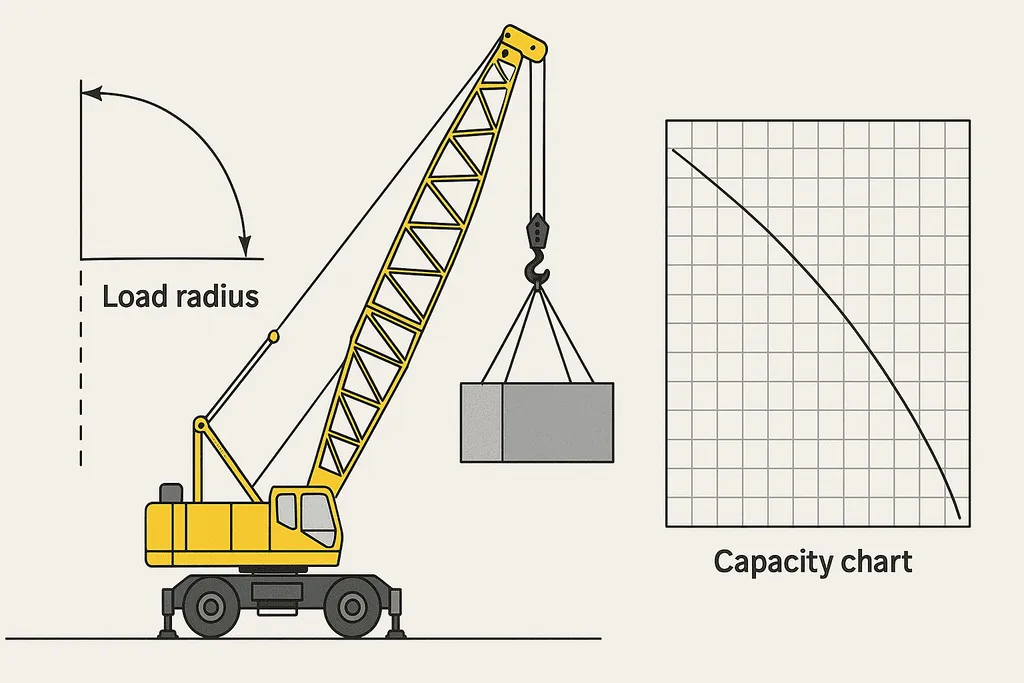
- Load chart: A table showing the crane’s allowable load corresponding to different working radii and boom lengths.
- Working radius: Horizontal distance from the crane’s swing center to the load’s center of gravity.
- Lifting accessories: Slings, shackles, hooks, spreader beams, frames—each has weight and must be included in the total lifting load.
Factors Affecting the Crane’s Safe Lifting Capacity
In real-world operations, a crane’s safe capacity can vary greatly depending on boom length, radius, ground condition, and sling angle. Understanding these factors helps you apply crane load calculations more accurately and avoid the common mismatch between theoretical and on-site capacity.
- Boom length & working radius: The farther the crane reaches, the lower the allowable load.
- Lifting height: Different boom configurations affect allowable load values on the load chart.
- Ground conditions: Weak or uneven ground drastically reduces safety, even with correct calculations.
- Sling angle: Smaller angles (more horizontal slings) dramatically increase tension in each leg.
- Dynamic factors: Wind, sudden movements, or abrupt stops add extra forces beyond static load.
Step-by-Step Process to Calculate Crane Load
Professional crane load calculation requires a structured approach—not assumptions. Below is a four-step workflow used by lifting teams before each operation to ensure safety and cost efficiency.
- Step 1: Determine the exact weight of the load
Use drawings, catalogs, or manufacturer labels. If unavailable, calculate volume × density (e.g., concrete ≈ 2.4 t/m³, steel ≈ 7.85 t/m³). Never estimate vaguely when performing crane load calculations. - Step 2: Add the weight of lifting accessories
Total lifted load must include: item weight + slings + shackles + hooks + lifting beams + hook block.
Total lifting weight = Load weight + Accessory weight + Lifting frame weight. - Step 3: Identify crane configuration and read the load chart
Determine working radius, height, boom length, and boom angle. Then check the load chart. The crane’s allowable load must exceed calculated lifting weight, with an added 20–30% safety margin. - Step 4: Reassess sling angle and site conditions
Calculate tension in each sling leg based on angle. Smaller angles create significantly higher forces. Also check ground stability, wind, obstacles, and communication signals.
Real-World Example: Calculating Crane Load for a Lift
A real example makes it easier to understand how to apply crane load calculations. This type of scenario is common when lifting machinery or large steel structures.
Example scenario:
- Load: Bulldozer weighing 12 tons
- Accessories: Slings, shackles, hooks, frame ≈ 1 ton
- Total static load: 13 tons
- Working radius: 8 m; Lifting height: 6 m
If the load chart for a 25-ton crane shows an allowable load of 16 tons at an 8 m radius:
- 13 tons < 16 tons → theoretically acceptable
- However, subtracting 20–30% margin for dynamic forces may reduce usable capacity
- If the effective capacity is only 12–13 tons, the lift is borderline → using a larger crane or reducing radius is safer
This demonstrates that crane load calculation requires evaluating all variables—not just the load weight.
Common Mistakes in Crane Load Calculation
Most crane accidents stem from overlooked details in crane load calculation. Recognizing these mistakes helps protect workers, property, and project timelines, especially in densely populated urban lifting operations.
- Ignoring accessory weight: Slings, hooks, and frames can add 5–20% to total weight.
- Not reading the correct load chart section: Many rely only on crane tonnage (10t, 25t) instead of radius-based capacity.
- Misjudging sling angles: Horizontal slings significantly increase tension.
- Poor ground preparation: Soft or uneven ground causes unequal outrigger loading and instability.
- No lift supervisor: Lack of proper signaling and coordination increases risk.
Tips for Choosing the Right Crane and Operator
Alongside proper crane load calculation, choosing the right crane and an experienced lifting team is crucial. A professional service provider ensures safe, efficient, and cost-effective lifting operations.
- Always request a site survey to measure radius and pathways accurately.
- Choose a crane with higher capacity than calculated requirements.
- Ensure operators, riggers, and supervisors are certified and experienced.
- Ask for safety records, maintenance logs, and valid inspection certificates.
- Professional teams such as those at Phuong Gia Foundation provide standard lift plans for approval.
FAQ – Frequently Asked Questions About Crane Load Calculation
This section summarizes essential points on crane load calculation, useful for investors, supervisors, and safety officers.
How do I know if a crane has enough capacity for my load?
First calculate the total load including accessories. Then check the load chart for the correct boom length and working radius. If allowable capacity exceeds total load with sufficient safety margin, the crane is suitable.
Do I need to add accessory weight to the calculation?
Yes. Slings, shackles, hooks, frames, and hook blocks all add weight. Forgetting them results in inaccurate crane load calculations and unsafe lifting conditions.
How does sling angle affect lifting capacity?
Smaller angles between sling legs increase tension significantly. Even if the load weight is unchanged, tension on each sling may exceed its capacity. Always aim for near-vertical sling angles.
When should I hire a professional to calculate crane load?
When lifting heavy loads, oversized items, or operating in restricted areas. Complex lifts require engineered lift plans and experienced supervisors—not just basic load estimation.
Conclusion: Safe and Accurate Crane Load Calculation
Applying the correct crane load calculation ensures lifting operations run safely, efficiently, and cost-effectively. From confirming load weight to reading the load chart, checking sling angles, and evaluating site conditions, every step matters. When combined with an experienced lifting team, risks such as crane overturning or property damage are greatly reduced. For crane rental in Ho Chi Minh City and nearby provinces, contact Phuong Gia Foundation – Hotline: 0948952024 or 0824 255 5855.