

When operating a crane—from mobile cranes to boom trucks—one small lapse can cause major damage to people and property. Drawing on hundreds of real lift jobs each year, Phương Gia Foundation shares a practical, field-tested approach to crane safety that helps you control risk, cut costs, and reduce downtime. This guide covers pre-operation checks, reading the load chart, setting safe zones, and a step-by-step lifting procedure with a real-world example your crew can apply immediately.
Core principles for safe crane operation
To operate a crane correctly, base every decision on data: load, radius, ground capacity, and machine configuration. Standardizing the routine reduces errors, boosts productivity, and raises overall crane safety on site.
- Never exceed the Safe Working Load (SWL – Safe Working Load).
- Set outriggers on proper pads; verify level and ground bearing capacity.
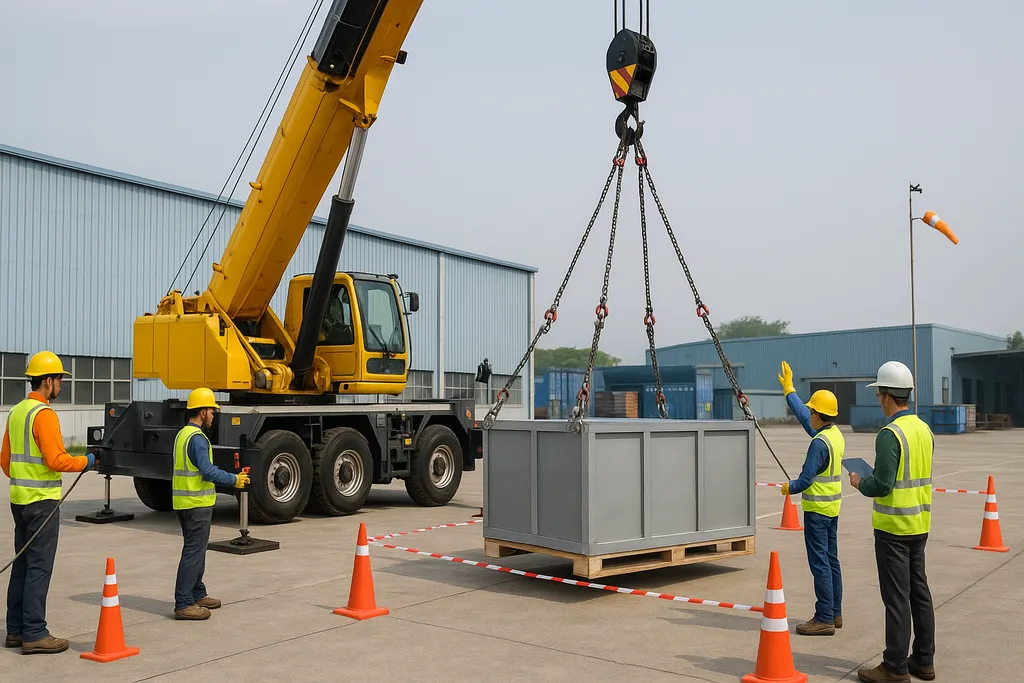
- Establish an exclusion zone and safe walkways; only assigned personnel enter.
- Single communication channel: one designated signaler coordinates the lift.
- Never travel a load over people; no one under the load; use tag lines to control swing.
Pre-operation checks: equipment, ground, crew
Pre-checks protect crane safety and schedule. Follow the same checklist every shift to avoid omissions. Cover the machine, rigging gear, ground conditions, weather, and team readiness.
- Equipment: hydraulics, brakes, load moment indicator, hook, safety latches.
- Rigging: wire ropes, chains, shackles; tags, capacities, valid inspection records.
- Ground & surroundings: level, settlement, bearing capacity, overhead hazards (power lines, beams, trees).
- Weather: wind, rain, visibility; define stop thresholds for strong gusts and slippery surfaces.
- Crew: clear roles, risk briefing, agreed hand signals and radio channel.
- 60-second mini-checklist: valid inspection certificates; correct outrigger pads; radios on the same channel; trial lift 10–15 cm to verify balance and brakes.
Read the load chart and determine safe capacity (SWL)
Accurate crane operation requires reading the load chart for the actual radius and boom angle. Calculate total load (load + hook block + rigging) and compare with SWL in the working configuration. Only lift if a safety margin remains.
- Confirm radius, boom angle, and working position on site.
- Compute total load: load + rigging (slings, shackles, spreader, hook block).
- Use the correct chart configuration (with/without jib, boom sections).
- Apply margin for wind, oscillation, and leveling tolerances.
- Example: load 3.2 t + rigging 0.3 t = 3.5 t; at 18 m radius, SWL 4.0 t ⇒ safe to lift.
On-site lifting procedure, step by step
A standard procedure helps the crew get it right the first time. Prepare a lift plan with a site sketch, crane position (mobile crane or boom truck), travel path, and exclusion zones. Cross-check each step to maintain safe crane operation.
- Plan & permit: lift permit with position drawing, load calculations, and responsibilities.
- Set exclusion zones, barriers, and signs; assign spotters for entry points.
- Deploy outriggers on pads; level the crane with the bubble indicator.
- Rig correctly: choose slings with adequate capacity and sling angles to the horizontal ≥ 45° (ideally 60°); protect sharp edges.
- Trial lift 10–15 cm: verify balance, stability, brakes, and clear comms.
- Lift–slew–travel slowly: keep load close to the ground; use tag lines to limit rotation.
- Set down & de-rig: lower smoothly, hands clear; remove barriers and document handover.
Managing risks: weather, ground, and communications
Environment directly affects crane safety. Define wind/visibility stop thresholds and standardize communications to avoid conflicting commands. Brief these rules before each shift.
- Wind: stop when wind exceeds the maker’s limit; be cautious with wind-sensitive loads (panels, tanks, sheets).
- Rain & night: increase lighting, anti-slip measures, and reduce maneuver speed.
- Ground: mark potential settlement areas; temporarily backfill trenches before positioning the crane.
- Comms: one person issues commands; unified hand signals; spare radios with full batteries.
Maintenance, inspections, and compliance
Complete records strengthen trust and satisfy audits. Preventive maintenance, valid inspections, and a shift log demonstrate correct technique and operational discipline. At Phương Gia Foundation, we standardize forms to ensure end-to-end control.
- Maintenance schedule: oil changes, cylinder checks, safety systems, load sensor calibration.
- Inspections: crane and lifting gear with valid certificates and tags.
- Operations log: crew, weather, location, load, incidents (if any) and corrective actions.
- Rigging dossiers: sling/shackle certificates; track usage cycles; retire damaged gear.
Real-world example: saving time and cost
To install a 3.2-ton CNC on the 2nd floor via a narrow alley, the team selected a 25-ton crane at 18 m radius to keep a capacity buffer. Using a two-leg sling at 50° plus tag lines, a trial lift and outrigger tweaks cut duration by ~30% versus plan—typical for urban crane operations when renting 25–50 ton cranes for construction handling.
FAQ
The answers below address common questions about crane operation, helping you decide quickly and maintain lifting safety in the field.
When should I stop lifting due to high wind?
Follow the manufacturer’s threshold and your lift plan; if wind exceeds limits or gusts are erratic, stop immediately to maintain crane safety. For wind-sensitive loads (panels, tanks), further reduce limits and use tag lines.
What’s the difference between SWL and test load?
SWL is the permitted working load under normal operation; test load is used during inspections to verify strength. For correct crane operation, never confuse the two—always lift at or below SWL with a safety margin.
Is a dedicated signaler mandatory?
Appoint one signaler for every lift to prevent conflicting commands, especially with limited visibility. This role is critical to a safe crane operation procedure, synchronizing the operator and rigging crew.
What crane capacity should I choose?
Base it on total load, radius, and crane position as shown on the load chart. Choose a configuration with 10–20% surplus for wind and dynamic effects. Share your site plan and load data for an optimized recommendation.
Conclusion & contact
To ensure safe crane operation, standardize the workflow—from pre-checks and load chart reading to exclusion zones and single-channel comms. We serve Ho Chi Minh City, Binh Duong, Dong Nai, and Long An, supporting you from survey to handover. Need to rent a crane in HCMC and nearby provinces? Contact Phương Gia Foundation – Hotline: 0948952024 or 0824 255 5855.