

To ensure safe crane operation and prevent unexpected downtime, a clear and practical crane inspection checklist is essential at every job site. Based on real field experience, Phương Gia Foundation provides a step-by-step pre-shift inspection process that helps detect failures early, comply with official crane certification requirements, and increase productivity. This guide applies to mobile cranes, truck-mounted cranes, knuckle boom cranes and industrial lifting operations in both urban and industrial environments.
Objectives and Scope of the Crane Safety Inspection
The checklist is designed to verify equipment condition, meet legal compliance, and prepare safe lifting conditions for every shift. It applies to cranes from 5–100 tons and above, including folding cranes, truck cranes, and port/crane yard applications. Proper execution reduces risks of cable failure, crane overturning, electrical contact and unnecessary crane maintenance costs.
- Confirm readiness of equipment, operators and jobsite conditions.
- Standardize pre-shift, mid-shift and post-shift inspections.
- Link inspection results with legal records and crane operation plans.
Verify Legal Documents & Technical Records
Before starting the engine, paperwork must be complete and accessible. Never “test lift” without valid documents—this is the foundation of every technical and safety decision.
- Valid inspection stamp/certificate; proof of load test.
- Maintenance logbook and latest repair records.
- Correct load chart for the crane model, including boom angle and radius limits.
- Certified operator, signalman, and rigger IDs with defined job roles.
- Lifting plan and jobsite risk assessment.
Mechanical – Hydraulic – Electrical Inspection
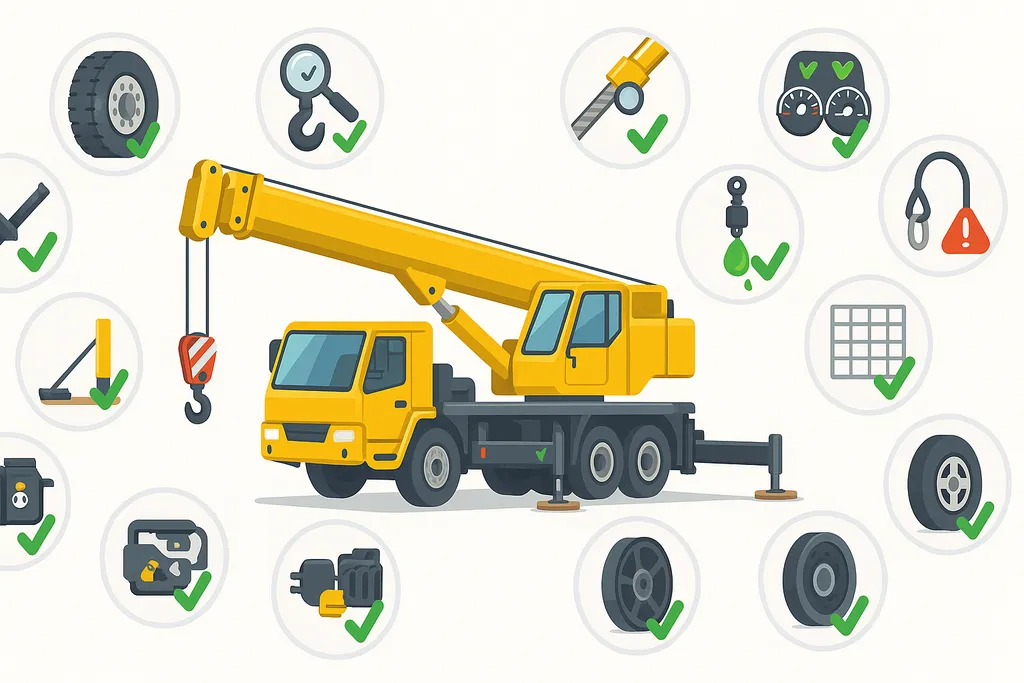
This is the core of the crane inspection checklist. Focus on chassis, slewing system, hydraulics, electrical control and safety limiters. Any leak, wear or abnormal signal must be logged and fixed before lifting.
- Chassis and slewing ring: no cracks, no excessive play; bolts tightened to spec.
- Hydraulic system: hoses, seals, fittings are dry; overload relief valve works; hydraulic oil at proper level.
- Load moment limiter (LML), boom angle sensors, height limiters: accurate and functional.
- Electrical/control: limit switches, horn, warning lights, diagnostic screen free of errors.
- Brakes, hoist, sheaves, crane hook: no cracks or deformation; safety latch intact.
Check Lifting Accessories & Rigging Gear
Rigging is the “weakest link” in crane operation. Only use accessories still within service life, clearly tagged and rated for the load (WLL). Replace immediately if damaged.
- Wire ropes, chains, webbing slings: no frays, kinks or excessive wear.
- Shackles, master links, wire rope clips: correct size, safety pin intact.
- Dynamometer or load cell for real-time load monitoring when required.
- Correct sling angles; use corner protectors to prevent sling damage.
Jobsite Setup & Safety Conditions
A safe lifting zone prevents crane overturning and electrical hazards. Check ground bearing capacity, outrigger setup and restricted areas before hoisting.
- Ground condition: compacted surface; place pads under outriggers.
- Safe distance from overhead powerlines according to voltage table.
- Wind, rain, visibility: compare with load chart limits; stop if exceeding threshold.
- Signal communication: dedicated signalman, hand signals or radio communication.
- Fire safety: extinguisher ready, evacuation route clear.
No-Load / Load Test & Sample Checklist Form
Warm up the system, test functions without load, then lift progressively at safe percentages. Record all results for traceability.
- Warm-up: boom up/down, swing, telescope with no load.
- Step-load test: 25% → 50% → 75% of rated load within safe radius.
- Test hoist brake, slewing brake, interlock system, limiters.
- Example: based on Phương Gia Foundation field data, no-load testing alone detects 60–70% of post-maintenance failures.
| Inspection Item | Status | Notes |
|---|---|---|
| Inspection stamp / Load chart | Pass / Fail | Legal compliance |
| Hydraulic leaks | Pass / Fail | Hoses, seals, valves |
| LML / Sensors | Pass / Fail | Accurate reading |
| Slings / Shackles | Pass / Fail | WLL matches load |
| Outriggers & ground | Pass / Fail | Load pads in place |
5 Common Crane Operation Mistakes to Avoid
Most accidents come from overlooked “small steps.” Use this list as a quick reminder.
- Ignoring load chart at real lifting radius or wind conditions.
- Using expired rigging gear or gear without WLL tags.
- No ground pads under outriggers, causing sinking or tilt.
- Lifting while swinging with off-center load.
- No written checklist → root cause lost after incident.
FAQ
When should the crane inspection checklist be performed?
Before every shift, after every shift (quick check), and after major repair or maintenance. Increase frequency for harsh environments.
Is the correct load chart mandatory?
Yes. A mismatched chart leads to wrong radius/load calculation and high overturning risk.
How to check ground support for outriggers?
Verify soil bearing capacity, use proper mats, avoid manholes, edges, or newly filled ground.
LML shows overload but the load “looks light” — what now?
Stop immediately, lower load, re-check radius, boom angle, wind and sensor calibration. Never bypass safety systems.
How to select proper rigging accessories?
Choose WLL ≥ load weight, correct material, reputable brand. Discard anything cracked, bent or missing safety pins.
Conclusion & Contact
A structured crane inspection checklist reduces accidents, extends machine lifespan and boosts productivity. From legal documents to mechanical checks, rigging inspection and load testing — every step protects workers and assets. Need assistance building on-site procedures, training operators, or renting certified cranes? Contact us anytime. Need crane rental service in Ho Chi Minh City and nearby provinces? Call Phương Gia Foundation – Hotline: 0948952024 or 0824 255 5855.