

In construction and logistics projects, safety standards and regulations for crane operation are essential to protect people, cargo, and project timelines. With extensive field experience, Phương Gia Foundation provides a practical perspective on legal requirements, risk-control procedures, and how to implement them correctly on site. This guide helps you understand responsibilities, build a safe crane operation workflow, set up inspection forms, and note key points on training, certification, and on-site coordination to minimize incidents.
Legal framework and safety standards for crane operation
To comply with crane safety regulations, contractors must follow Vietnam’s current technical standards, OEM manuals, and client requirements. It is recommended to align with an Occupational Health and Safety Management System (ISO 45001). All lifting equipment must have valid inspection certificates, a complete technical dossier, and a visible identification tag placed at an easy-to-check position.
- Legal documents: equipment dossier, inspection certificate, user manual, hand-over report.
- Internal procedures: safety rules, role assignment, reporting templates, emergency response plans.
- Signage & barriers: placed as required, updated lifting zone layout and evacuation routes.
Competency of operators, lifting supervisors, and riggers
Human competency is the key to safe crane operation. Operators must hold valid licenses, receive periodic training, and pass hands-on assessments. The lifting supervisor approves plans, assigns signalers, and oversees the entire operation. Riggers must understand slings, signals, anchor points, and load limits.
- Mandatory: operator license, medical check, OHS training, and operation test.
- Role clarity: operator – supervisor – signaler – rigger; use a unified signal system.
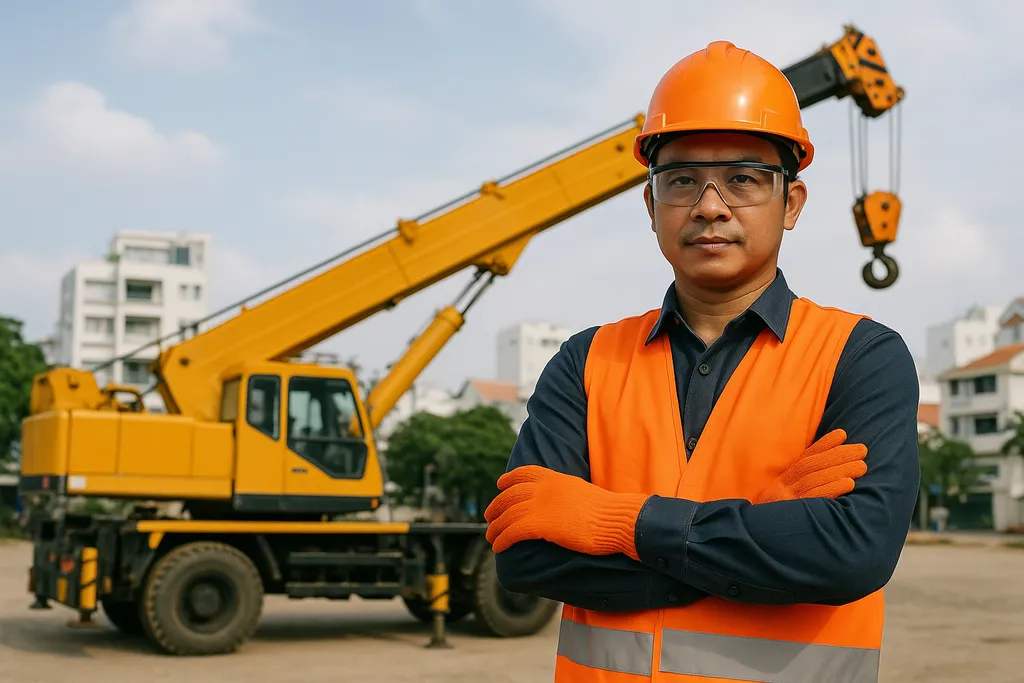
- PPE: helmet, gloves, safety boots, reflective vest; radios for noisy or low-visibility zones.
Lifting plan and risk assessment
Every critical lifting activity must have a detailed lifting plan with a risk assessment. The plan defines load weight, radius, path, outrigger setup, and preventive measures. Critical lifts require high-level approval and dry-run rehearsal. Phương Gia Foundation can support standardized templates to reduce on-site errors.
- Main contents: lifting diagram, rigging layout, boom swing clearance, wind limits, obstacles.
- Typical risks: weak ground, wind gusts, off-center loads, wrong anchor points, overhead lines.
- Controls: Permit to Work, toolbox meeting, emergency stop protocol.
Load management: load chart and SWL
Every lifting decision must follow the manufacturer’s load chart and the Safe Working Load (SWL). Operators must interpret boom length, radius, angle, and counterweight correctly. Never combine capacities of different configurations; always take the most restrictive value and apply safety factors.
- Golden rule: if the chart allows 7.8 tons at the specified radius, you cannot lift 8 tons.
- Technical control: Load Moment Indicator (LMI) must be functional and calibrated.
- Rigging: slings, shackles, hooks must show clear SWL tags, free from wear, twist, or crushing.
Pre-operation inspection and safety checklist
A checklist before each shift ensures compliance with crane safety standards and detects early failures. Inspect hydraulics, electrics, brakes, alarms, lighting, sensors, and ground condition. Only operate when no leakage, warning alarm, or obstruction exists.
- Equipment: tires/cylinders/hoses, oil/grease, brakes, winch, hook, rope, sheave, LMI, lights/camera.
- Ground: leveled platform, cribbing under outriggers, remove manholes or soft spots.
- Organization: barricades in place, signage, signaler ready, trial lift before main load.
Working zone, weather, power lines, and special conditions
The lifting zone must be barricaded, traffic-controlled, and supervised. Monitor weather closely; suspend operations when wind exceeds OEM limits or lightning is present to ensure crane safety. Maintain safe clearance from power lines and assign dedicated spotters when required.
- Weather: stop lifting during gusty wind, heavy rain, poor visibility; use anemometer when needed.
- Power lines: survey, flag, request isolation if required; no standing under loads or swing radius.
- Night or confined lift: enhance lighting, cameras, mirrors, extra spotters.
FAQ
What does “crane inspection” include and how often is it required?
Inspection verifies compliance with safety regulations. It includes document checks, load testing, and assessment of lifting mechanisms, brakes, hydraulics, electrics, and safety devices. Frequency depends on equipment type and legal requirements.
What is the difference between SWL and WLL?
SWL (Safe Working Load) and WLL (Working Load Limit) both indicate the maximum safe load of equipment/rigging. Always follow the lowest rated value in the lifting setup to ensure crane safety.
When is a detailed lifting plan required?
For heavy, off-center, high-value loads, lifting near power lines, weak ground, confined space, or multi-crane tandem lifts, a lifting plan with risk assessment is mandatory.
How to read a load chart correctly?
Select the exact boom type, length, angle, radius, and counterweight, then match the table. Always choose the least favorable value, add margin for wind/sway, and never reuse values from a different configuration.
What should be done if the LMI issues a warning during lifting?
Stop, lower the load to a safe position, verify configuration and load chart. If the alarm persists, troubleshoot sensors/mechanics and only resume after clearance from a technician.
Conclusion & Recommendation
Following crane safety standards, training qualified personnel, preparing lifting plans, and performing pre-operation checks are the foundation of incident-free operations. Contractors should maintain inspection records, scheduled maintenance, standardized checklists, and empower lifting supervisors to stop unsafe work. Need crane rental in HCMC and nearby provinces? Contact Phương Gia Foundation – Hotline: 0948952024 or 0824 255 5855.