


When people hear terms such as “3-ton crane truck,” “5-ton crane,” or “7-ton crane,” they often assume that these figures determine whether the driver needs a C1 or C driving license. This is a common misunderstanding because the crane’s lifting capacity and the vehicle weight used to determine the driving license category are two completely different specifications.
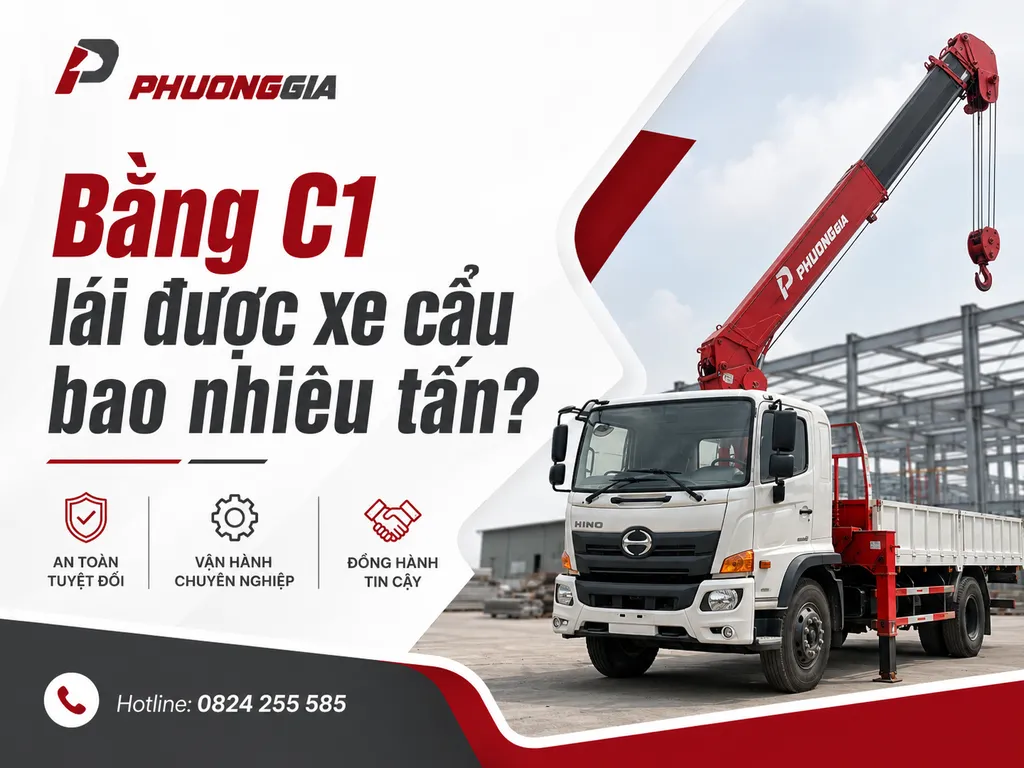
The key figure to check is not how many tons the crane can lift, but the design gross vehicle mass. This is one of the main specifications used to determine whether a vehicle falls within the scope of a C1 driving license.
Therefore, to correctly answer the question “What crane truck weight can a C1 license drive?”, it is necessary to separate two issues: the license required to drive the vehicle and the lifting capacity of the crane mounted on that vehicle.
What Crane Truck Weight Can a C1 License Drive?
Quick answer: Under Vietnam’s current driving license classification system, a C1 license allows the holder to drive trucks and specialized motor vehicles with a design gross vehicle mass of over 3,500 kg up to 7,500 kg. For a truck-mounted crane, the classification must be based on the specifications of the entire vehicle, not on whether the crane itself can lift 3 tons, 5 tons, or 7 tons.
In other words, the 7,500 kg limit for a C1 license does not mean that a C1 holder may drive any crane truck capable of lifting up to 7.5 tons. A crane with a lifting capacity of only 3 tons may still be installed on a chassis whose design gross vehicle mass exceeds 7,500 kg.
Likewise, seeing a “5-ton crane” specification is not enough to conclude that the driver needs a C license. The actual vehicle documents must be checked before determining the appropriate license category.
What Does the 7.5-Ton C1 Limit Actually Refer To?
This is the most important point to understand. If the word “ton” is interpreted incorrectly, it is very easy to assign the wrong driver or misunderstand the legal classification of a crane truck.
| Specification | Meaning | Used Directly to Determine C1 Eligibility? |
|---|---|---|
| Design gross vehicle mass | The maximum total mass of the complete vehicle according to its approved design | Yes |
| Crane lifting capacity | The amount of load the crane can lift under specified operating conditions | No |
| Weight of the load being lifted | The actual weight of the machine, equipment, or cargo being lifted | No |
| Unladen vehicle mass | The mass of the vehicle before considering its full permitted load | Should not be used alone to determine the license category |
For example, a company may need to lift a machine weighing only 2 tons. That does not automatically mean a C1 license is sufficient for the crane truck sent to the site. A larger chassis may be required because of a long lifting radius, greater lifting height, outrigger requirements, or stability considerations.
Therefore, the weight of the load being lifted does not determine the required driving license category.
Why Does a “5-Ton Crane Truck” Not Automatically Fall Under C1?
In everyday operations, crane trucks are often referred to by their lifting capacity because this makes communication easier. However, such commercial naming is not precise enough to determine the required driving license.
Suppose a dispatcher receives a request for a “5-ton crane truck.” Before assigning a driver, the dispatcher needs to determine exactly what the 5-ton figure refers to. If it represents the crane’s nominal lifting capacity, it still provides no direct information about the design gross vehicle mass.
The same crane model can be installed on different chassis configurations. The number of axles, chassis length, cargo bed, additional equipment, and installation configuration can all affect the total vehicle mass.
This is why two vehicles commonly called “5-ton crane trucks” may not necessarily require the same driving license category.
How Is Design Gross Vehicle Mass Different From Payload and Crane Capacity?
These three concepts often appear together when discussing truck-mounted cranes, but each serves a different purpose. Understanding the distinction helps prevent most C1-related mistakes.
Design Gross Vehicle Mass
This is a specification of the complete vehicle and should be checked when determining the required driving license category. The value should be taken from valid documents for the actual vehicle rather than estimated visually or copied from a similar vehicle found online.
Unladen Vehicle Mass
This refers to the mass of the vehicle in the condition specified by its technical documentation. Looking only at the unladen mass is not enough to determine whether the vehicle falls under C1 because the important threshold relates to the design gross vehicle mass.
Crane Lifting Capacity
This is a technical characteristic of the lifting equipment. A crane’s lifting capacity is not necessarily constant at every boom position. As the working radius increases, the permitted lifting load generally changes according to the load chart of that specific crane.
For this reason, saying “a 5-ton crane can lift 5 tons at any position” is also inaccurate. The operator must consider the load chart, working radius, boom length, boom angle, and actual site conditions.
How Does a C1 License Apply to a Truck-Mounted Crane?
Truck-mounted cranes are among the most commonly misunderstood cases because a single vehicle combines road transport, cargo handling, and lifting functions.
When the truck travels on public roads, the driver’s license category must be suitable for the vehicle type and its design gross vehicle mass. Whether the truck is carrying a light load or is not using the crane that day does not change the license category required for that vehicle.
When the truck reaches the job site and starts lifting, additional considerations apply to the person operating the crane, including operational competence, safety procedures, load charts, and working conditions.
A simple way to understand the distinction is:
- Driving the vehicle: check the vehicle category and the appropriate driving license.
- Operating the crane: check the operator’s competence and applicable safety requirements.
- Lifting the load: check the load weight, lifting radius, lifting height, boom configuration, and site conditions.
These three issues are related, but they should not be treated as one and the same.
When Does a Crane Truck Require a C License Instead of C1?
If a truck or specialized motor vehicle has a design gross vehicle mass exceeding 7,500 kg, it falls outside the weight range of a C1 license and the appropriate higher license category must be considered under the current regulations.
| License Category | Relevant Weight Range | Key Point for Crane Trucks |
|---|---|---|
| C1 | Over 3,500 kg up to 7,500 kg | Check the design gross vehicle mass of the complete vehicle |
| C | Over 7,500 kg | Do not determine the category from crane lifting capacity |
For example, if a truck carries a crane with a nominal lifting capacity of only 3 tons but the vehicle’s design gross vehicle mass exceeds 7,500 kg, the “3-ton crane” description cannot be used to justify driving it with a C1 license.
Similarly, a crane with a high lifting capacity does not automatically determine the driving license category. Check the vehicle documents first, then compare them with the driver’s license category.
How to Check Whether a Crane Truck Falls Within the C1 Category
In practice, the safest approach is not to memorize different crane truck models. Instead, check the actual vehicle and its official specifications.
Identify the Exact Vehicle Type
First determine whether the vehicle is a truck-mounted crane, a specialized motor vehicle, or another type of mobile crane. Not every vehicle commonly called a “crane truck” should automatically be treated the same way.
Check the Documents for the Actual Vehicle
Do not use specifications from another truck of the same model found online as a substitute for the documentation of the actual vehicle. Even the same chassis model may have different cargo beds, crane installations, modifications, and approved technical specifications.
Find the Design Gross Vehicle Mass
This is the specification that should be prioritized when comparing the vehicle with the C1 weight range. If the value is over 3,500 kg and up to 7,500 kg, and the vehicle type is within the scope of C1, there is a basis for determining whether a C1 license is appropriate.
Check the Driver’s License
It is not enough to confirm that the driver “has a license.” The company should check the correct license category, validity, and whether it is suitable for the assigned vehicle.
Check Crane Operating Requirements Separately
A suitable driving license does not replace the need to assess whether the person is qualified to operate the lifting equipment. If the driver also directly operates the crane, the company should separately verify relevant training, safety requirements, work assignment, and operational competence.
Is a C1 License Alone Enough to Operate a Crane?
No, it should not be understood that way. A C1 driving license determines which categories of road vehicles the holder may legally drive. It does not automatically prove that the person is competent to perform all crane lifting operations.
A crane operator needs to understand factors such as permitted lifting loads, working radius, load charts, boom length, outriggers, ground conditions, boom angles, overhead obstacles, and communication with signal personnel.
One common mistake is focusing only on the weight of the item being lifted. For example, a load may weigh just 2 tons, but if it must be lifted at a long radius, the crane’s permitted lifting capacity at that position may be significantly lower than its rated capacity close to the truck.
Therefore, checking the driving license is only one step. The correct vehicle, qualified operator, and suitable lifting plan must all be considered together.
Are Mobile Cranes Treated the Same as Truck-Mounted Cranes?
It is not advisable to apply one conclusion to every vehicle commonly referred to as a crane truck. A truck-mounted crane and a purpose-built mobile crane may have different structures, vehicle documents, and operating purposes.
For specialized mobile cranes, the correct approach is still to identify the exact vehicle category shown in its documentation, check its approved design mass, and compare that information with the applicable driving license category.
This is also why the statement “the load weighs 5 tons” is usually not enough when selecting a crane for a job. A proper assessment also considers the truck position, distance from the crane to the load, lifting height, access road, outrigger space, and surrounding obstacles.
Common Real-World Situations That Cause Confusion About C1 Licenses
The following examples illustrate why a driving license category should never be determined solely by a crane truck’s commercial name.
The Vehicle Is Called a “3-Ton Crane”
A person may assume that 3 tons is below 7.5 tons, so a C1 license must be sufficient. This compares two figures that represent different things. The 3-ton figure may refer to lifting capacity, while the 7.5-ton threshold refers to design gross vehicle mass.
The Crane Truck Is Only Lifting a 1.5-Ton Load
A light load does not reduce the driving license requirement for the vehicle. If the truck itself falls outside the C1 weight range, a C1 license does not become sufficient simply because the load being handled that day is light.
The Same Crane Is Installed on Two Different Chassis
This is an important practical example. The lifting equipment may have nearly identical performance, but the vehicles can have different design masses because of differences in chassis, axle configuration, cargo bed, and installation design.
A Customer Requests a “7-Ton Crane Truck”
When receiving the request, the supplier should clarify whether “7 tons” refers to the load weight, desired lifting capacity, or simply a common market name for the crane. Asking this question early can prevent the wrong vehicle from being dispatched.
What Should a Company Check Before Assigning a Crane Truck Driver?
In addition to determining whether a C1 license is suitable for the crane truck, companies should follow a short pre-assignment inspection process to reduce both documentation and operational risks.
- Compare the driver’s license category with the actual vehicle assigned.
- Check the validity and status of the driver’s license.
- Review the vehicle registration, documentation, and applicable inspection status.
- Confirm that the operator understands the crane installed on the vehicle.
- Inspect outriggers, hooks, wire ropes, and lifting accessories before operation.
- Assess the ground condition and space required to deploy the outriggers.
- Confirm the actual weight of the load.
- Determine the expected lifting radius and height.
- Compare the lifting plan with the crane’s load chart.
- Check whether the access road is suitable for the size and weight of the vehicle.
An important operational lesson is that choosing a crane based only on the load weight is not enough. A relatively light machine located deep inside a factory or far from the truck position may require a completely different crane configuration from the same machine placed directly beside the vehicle.
Should Customers Hiring a Crane Care About the Driver’s License?
The customer is not normally responsible for assigning the driver’s license within the crane service provider’s workforce. However, customers should still choose a supplier with clear procedures for managing vehicles, drivers, operators, and lifting safety.
This is particularly important when lifting machinery, industrial equipment, production lines, or high-value cargo.
When assessing a lifting job, information such as the load weight, dimensions, pick-up location, placement location, expected lifting radius, lifting height, access road, and available setup space is usually more useful than simply asking, “How many tons should the crane be?”
Common Misunderstandings About C1 Licenses and Crane Trucks
Most mistakes happen because a correct specification is used for the wrong purpose. The following assumptions should be avoided:
- “A C1 license can drive a crane that lifts up to 7.5 tons.” Incorrect. The 7.5-ton figure does not refer to crane lifting capacity.
- “It is a 5-ton crane, so C1 must be enough.” Not enough information. The design gross vehicle mass must still be checked.
- “The truck is empty today, so a lower license category is acceptable.” The required license is not determined by how much cargo the vehicle carries on a particular trip.
- “A C1 license is all that is needed to operate the crane.” Driving authorization and crane operating competence must be considered separately.
- “Two trucks with the same crane model have identical requirements.” Their chassis configuration and approved vehicle specifications may differ.
Frequently Asked Questions About C1 Licenses and Crane Trucks
The following questions provide quick answers to the most common issues before checking the documentation of a specific vehicle.
What truck weight can a C1 license drive?
A C1 license applies to trucks and specialized motor vehicles with a design gross vehicle mass of over 3,500 kg up to 7,500 kg under Vietnam’s current driving license classification system.
What crane truck weight can a C1 license drive?
The answer cannot be determined from the crane’s lifting capacity. The design gross vehicle mass of the complete vehicle must be checked. If the vehicle category falls within the scope of C1 and its design gross vehicle mass is over 3,500 kg up to 7,500 kg, it may fall within the C1 range.
Can a C1 license drive a truck with a 5-ton crane?
Not necessarily. A 5-ton lifting capacity does not reveal the design gross vehicle mass. Depending on the chassis and vehicle configuration, the complete vehicle may fall within or exceed the C1 weight range.
Does a 7-ton crane automatically require a C license?
No. If 7 tons refers to the crane’s lifting capacity, that figure does not directly determine the required driving license. The specifications of the complete vehicle must be checked.
When does a crane truck require a C license?
For trucks and specialized motor vehicles with a design gross vehicle mass exceeding 7,500 kg, the C1 range is no longer applicable and the appropriate higher license category must be considered according to the current regulations and actual vehicle type.
Is a C1 license enough to operate a crane?
A C1 license should not be treated as the only requirement for operating lifting equipment. The operator must also meet the applicable requirements for competence, training, safety, and work assignment.
Where should the crane truck specifications be checked?
The most reliable approach is to review the valid registration, inspection, and technical documentation of the actual vehicle being used. Do not rely solely on a commercial name or specifications from a similar vehicle found online.
Conclusion: Check the Vehicle Weight Before Looking at Crane Capacity
When answering the question “What crane truck weight can a C1 license drive?”, the most important principle is not to compare the crane’s lifting capacity with the 7.5-ton C1 threshold.
A C1 license applies to trucks and specialized motor vehicles with a design gross vehicle mass of over 3,500 kg up to 7,500 kg within the scope of this license category. Therefore, a “3-ton crane truck” is not automatically suitable for a C1 driver, while a vehicle commonly called a “7-ton crane” cannot automatically be assumed to require a C license.
The correct process is to identify the vehicle type, check the official documents of the specific vehicle, compare its design gross vehicle mass with the driver’s license category, and separately verify the operator’s competence to use the crane. Following this sequence helps avoid most mistakes when assigning drivers and planning lifting operations.