


The 2025 inspection regulations for crane trucks introduce important updates on inspection intervals, documentation requirements, and technical conditions. With practical experience operating crane fleets for businesses, Phương Gia Foundation summarizes key legal changes, real-world cases, and preparation tips to help vehicle owners save time and avoid inspection rejection. This guide applies to truck-mounted cranes, self-propelled cranes, and mobile cranes on tires or tracks when operating on public roads.
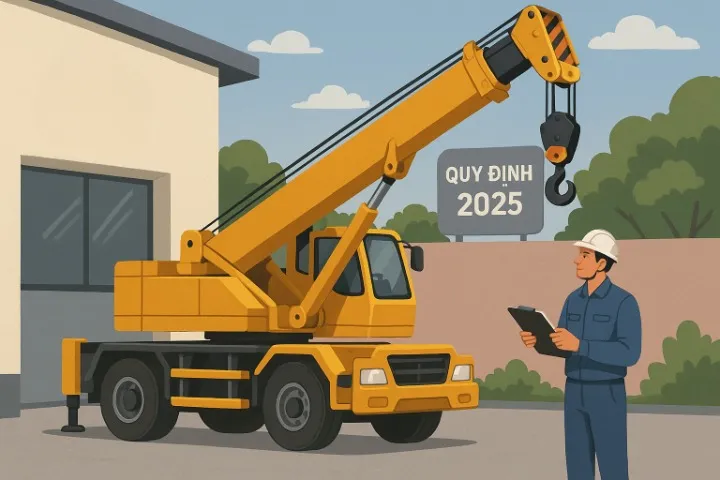
Crane vehicle classification & scope of inspection in 2025
Correctly identifying the vehicle category determines the correct inspection procedure. Depending on configuration, a crane may be classified as a truck-mounted crane (road motor vehicle) or a specialized mobile machine (rubber-tired or crawler crane not mounted on a truck). The classification decides the inspection interval, required documents, and inspection authority.
- Truck-mounted cranes/self-propelled cranes: subject to roadworthiness and environmental inspection at official vehicle inspection centers. Interval depends on vehicle age, transport purpose (commercial or non-commercial), and whether the vehicle has been modified.
- Rubber-tired or crawler cranes (not truck-mounted): when driving on public roads, they must be registered as special-purpose machines and inspected under a separate regulation set.
Inspection intervals for crane trucks in 2025
The 2025 regulation standardizes inspection intervals based on vehicle type, age, and usage purpose. Key note: modified vehicles (converted or crane-installed units) have shorter intervals; commercial vehicles are inspected more frequently than non-commercial ones. Most truck-mounted cranes fall into 6–12-month cycles; special-purpose cranes follow separate annex schedules.
- Age calculation: based on year of manufacture, not year of first registration.
- Example: a modified truck-mounted crane is typically inspected every 6 months; the same model without modification and with low age may qualify for 9–12 months.
- Quick check: refer to the latest interval annex, match vehicle age and usage type.
Required documents for 2025 crane inspection
A complete file minimizes waiting time and prevents rejection. Many centers now allow online pre-submission, but paper copies are still needed for verification.
- Truck-mounted/self-propelled cranes: vehicle registration, previous inspection certificate (if any), valid liability insurance, legal papers proving modification approval (if applicable), current inspection sticker, owner information.
- Special-purpose cranes: special-purpose vehicle registration, quality certificate (imported or domestic), modification dossier (if any), relevant insurance.
- 2025 update: some centers require updated digital forms; bring PDF scans for online upload when requested.
Technical failures that most often cause crane trucks to fail inspection
Inspection results are based on major systems such as brakes, lighting/signals, emissions, noise level, tires, and steering/suspension. For crane-equipped vehicles, special attention is given to mounting structure, axle load, and load chart plate.
- Braking issues: low brake efficiency, uneven brake force between wheels, long stopping distance.
- Emission/noise violations: exceeding thresholds for trucks or special-purpose vehicles.
- Crane installation: checking reinforcement structure, hydraulic lines, safety valves, overload alarm, and readable load chart.
Mandatory safety inspection for lifting equipment (separate from road inspection)
Many owners focus only on road inspection and forget the legally required occupational safety inspection for lifting equipment. Truck cranes, gantry cranes, overhead cranes, hoists, winches, etc. must undergo initial, periodic, or ad-hoc safety inspections by licensed organizations.
- Usual documents: valid safety inspection certificate, maintenance logbook, operator safety training certificates (group 3–4).
- Tip: bring the lifting equipment safety certificate when doing road inspection — many centers cross-check documents for safety consistency.
Practical checklist to pass inspection on the first try
The 2025 regulation allows flexible inspection locations (on-site or at the center if conditions allow). However, preparation at the workshop is still the deciding factor. Below is a verified checklist used for construction cranes and interprovincial fleets.
- Document check: registration, insurance, modification papers, previous inspection sticker, lifting equipment safety report.
- Pre-inspection test: private brake roller test, oil leak check, headlight alignment, CO/HC or smoke test depending on fuel type.
- Tire & axle load check: replace cracked/worn tires, re-weigh vehicle with crane installed to stay within road load limits.
- Plates & labels: reprint load chart, warning decals, clean chassis and engine numbers.
- Time slot: book early, arrive before peak hours to allow fixing time if needed.
Full-service inspection support for corporate crane fleets
For mixed fleets (truck cranes, tractor-mounted loaders, mobile cranes), companies should use a centralized inspection management service to track deadlines, arrange pre-inspection repairs, and handle legal modification approval. Phương Gia Foundation provides consulting, paperwork standardization, and workshop coordination to reduce vehicle downtime.
FAQ
Are truck-mounted cranes exempt from first-time inspection?
No, not by default. First-time inspection exemption applies only to certain unused vehicles; modified crane vehicles are generally not exempt and must be inspected.
What is the inspection interval for a modified crane truck?
Depends on vehicle age and usage type, but modified vehicles often follow shorter cycles (e.g. 6 months). Always check the latest interval annex.
Do mobile cranes need registration to drive on public roads?
Yes. Special-purpose vehicles must be registered, plated, and inspected when operating on public roads.
Is safety inspection for lifting equipment mandatory?
Yes. All cranes, including truck-mounted ones, are legally classified as high-risk lifting equipment and must undergo certified safety inspection.
What technical issues most commonly fail crane truck inspection?
Low brake efficiency, uneven brake force, emissions over limit, incorrect tire load rating, unreadable load chart, and hydraulic oil leaks.
Conclusion & recommendations
In 2025, crane inspection requirements emphasize both road safety and lifting equipment safety. Owners should verify the correct inspection interval, prepare documents, do pre-inspection checks, and maintain valid safety certificates to ensure first-time approval. Need crane rental in Ho Chi Minh City or nearby provinces? Contact Phương Gia Foundation – Hotline: 0948952024 or 0824 255 5855.