

In office cleaning contracts, the phrase “keep all areas clean at all times” may sound clear, but in practice it is difficult to inspect and verify. A cleaner may consider the job complete, while the Admin still notices fingerprints on glass doors, nearly full waste bins, or standing water on the restroom floor.
The problem is not always that the cleaning team has missed a task. In many cases, both parties simply have not agreed on what “acceptable cleanliness” actually means. Without specific criteria, quality assessment can quickly become subjective: one person thinks the area is clean, while another does not.
This is where an SLA becomes useful in cleaning management. A well-designed SLA turns general expectations into conditions that can be observed, checked, recorded, and corrected.
Quick answer: An office cleaning SLA is an agreement that defines the level of cleaning quality a cleaning team or contractor is expected to achieve. It typically specifies the areas covered, acceptance criteria, inspection frequency, response time, resolution time, and the process for handling work that does not meet the agreed standard.
What is an office cleaning SLA?
An office cleaning SLA is a set of criteria used to determine whether cleaning performance meets the required service level. SLA stands for Service Level Agreement, which describes the expected level of service between the service provider and the client.
In office cleaning operations, an SLA does not necessarily need to be a separate document. It may be incorporated into a service contract, scope-of-work appendix, quality inspection checklist, or contractor KPI framework.
A practical SLA should answer at least six questions:
- Which areas are included in the cleaning scope?
- Which tasks must be performed?
- What result qualifies as acceptable?
- When will the result be inspected?
- How quickly must a failure be corrected?
- Who is authorized to confirm acceptance?
Example: “The restroom must be clean” is not a good SLA
Suppose a contract simply states: “The restroom must always be clean.” If a disagreement occurs, it is difficult to identify exactly what has failed because the word “clean” has not been defined.
A more measurable version could include:
- No visible litter on the floor at the time of inspection.
- No standing water that creates a slip hazard.
- Washbasins are free from visible residue or staining.
- Waste bins are not overflowing.
- Toilet paper and soap are replenished when included in the contract scope.
- No persistent abnormal odor remains after cleaning.
- Reported issues are corrected within the agreed response and resolution timeframe.
With these criteria, cleaners, supervisors, and office administrators all know what they are expected to inspect.
How are SLA, checklist, KPI, and Scope of Work different?
These four terms are often used together, but they serve different purposes in cleaning service management.
| Term | Key question | Example |
|---|---|---|
| Scope of Work | What work must be performed? | Vacuuming, mopping, waste collection |
| Checklist | Has the task been completed? | Floor mopped: Yes/No |
| SLA | What result must the completed work achieve? | No visible litter or standing water on the floor |
| KPI | How well is the service performing over time? | Percentage of items passing on the first inspection |
A cleaner may tick “floor mopped” on the checklist, yet the area may still fail the SLA if visible dirt, litter, or standing water remains during inspection.
A simple way to remember the difference is: Scope of Work defines what must be done; a checklist confirms that it was done; the SLA defines the quality that must be achieved; and KPIs track overall performance.
What should an office cleaning SLA include?
An SLA does not need to be excessively long. However, it must be clear enough that cleaners and inspectors do not have to guess what is expected. For most offices, at least six groups of information should be included.
Area scope
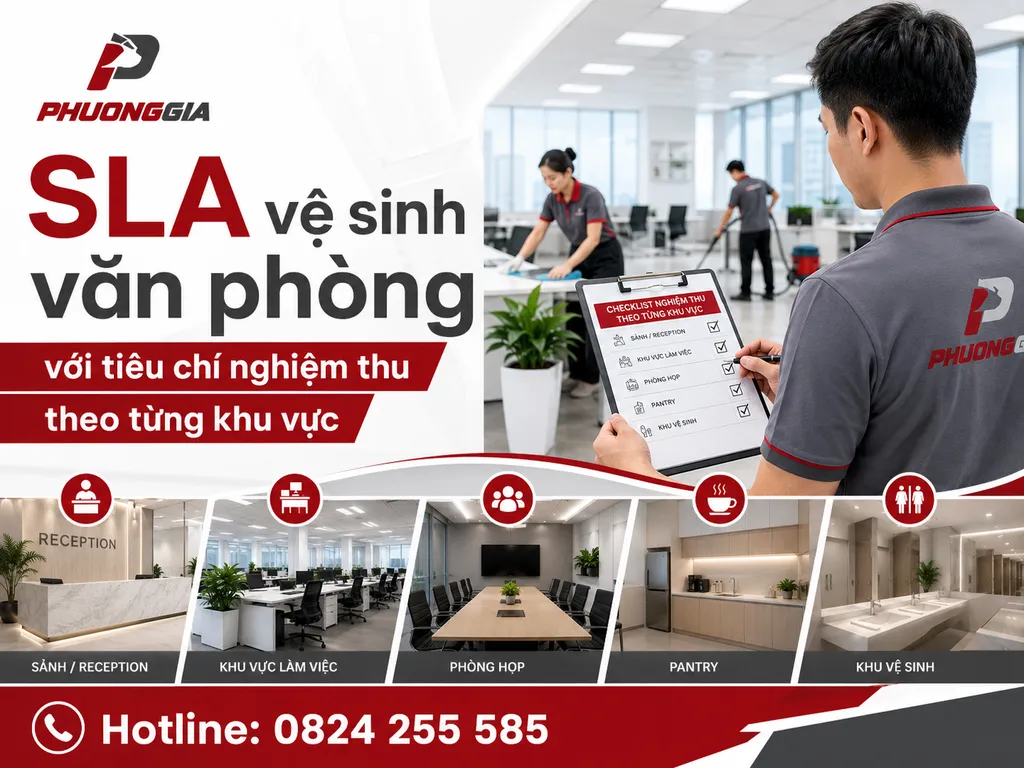
The workplace should be divided into areas with different usage patterns, such as:
- reception;
- workstations;
- meeting rooms;
- pantry;
- restrooms;
- corridors;
- floors;
- glass partitions;
- waste collection areas.
The same cleanliness criteria should not automatically be applied to every area because usage intensity and operational risks differ significantly.
Cleaning frequency and inspection frequency
These are two different concepts. An area may be cleaned twice per day while being inspected once per day or checked randomly by a supervisor.
A practical schedule should distinguish between routine cleaning, high-frequency cleaning, and periodic tasks so that the SLA reflects the actual workload instead of becoming a theoretical document.
Result-based criteria
Acceptance criteria should describe the required result rather than merely the activity performed.
- Avoid writing only: “Clean the glass.”
- Instead write: “No clearly visible fingerprints or wiping streaks within normal eye level.”
This distinction matters because an SLA measures the outcome, not simply whether an action was performed.
Response time and resolution time
Response time is the time between receiving an issue report and acknowledging or beginning to address it. Resolution time is the time required to fully correct the problem.
For example, spilled water in a main walkway may require an immediate response because it presents a safety risk. Completely removing a difficult stain, however, may take longer.
If an SLA only states “resolve within 15 minutes” without clarifying whether that means response or full resolution, disputes can easily occur.
Inspector and approver
In a small office, an administrator may perform the inspection directly. In larger offices, quality control often has several levels:
Cleaner self-check → Supervisor inspection → Admin or Facility spot check.
This structure reduces the situation in which every small problem must first be discovered by the client.
Corrective action process
Each failed item should follow a simple workflow:
Detect → Record → Classify → Correct → Reinspect → Close.
If the same defect repeatedly occurs, cleaning the area again is not enough. The supervisor should determine whether the real cause is insufficient cleaning frequency, lack of manpower, unsuitable tools, increased traffic, or poor task allocation.
5 principles for writing objective cleaning acceptance criteria
More SLA criteria do not necessarily produce better quality control. What matters is whether each criterion can actually be used during real inspections.
The criterion must be observable
“The floor looks clean and beautiful” is highly subjective. “No visible litter, hair, or water marks” is much easier to inspect consistently.
The criterion must be repeatable
If a supervisor and an Admin frequently produce opposite conclusions when checking the same criterion, the wording should be revised.
The inspection time must be defined
This is frequently overlooked. A restroom inspected immediately after cleaning at 8:00 a.m. is very different from the same restroom inspected at 11:00 a.m. after heavy use.
Instead of requiring an area to “remain clean at all times,” the SLA may define inspection cycles or specify the condition required immediately after task completion.
Cleaning defects must be separated from facility defects
Not every problem observed in an area is the responsibility of the cleaning contractor.
| Condition | Typical classification |
|---|---|
| Litter remains after the cleaning shift | Cleaning defect |
| Leaking faucet | Facility/maintenance defect |
| Overflowing waste bin | May fall under the cleaning SLA |
| Broken restroom light | Facility defect |
| Air-conditioner leakage onto the floor | Facility root cause, with temporary safety action required |
Do not make the SLA unnecessarily complicated
A checklist containing hundreds of items that nobody has enough time to inspect will quickly become a formality. Priority should be given to conditions that materially affect safety, employee experience, visitor impression, and daily operations.
Sample SLA acceptance criteria by office area
The following framework can be used as a starting point for an internal inspection form. Frequency and corrective-action timing should be adjusted according to floor area, occupancy, operating hours, and contractual scope.
| Area | Item | Acceptance criterion | Inspection method | Priority if failed |
|---|---|---|---|---|
| Reception | Floor | No visible litter, dust, or water marks | Visual inspection | Medium |
| Reception | Glass door | No obvious fingerprints at normal eye level | Visual inspection under available light | Medium |
| Workspace | Walkways | No litter or obstruction caused by cleaning activities | Visual inspection | High if movement is obstructed |
| Workspace | Waste bins | Not overflowing and no litter around the bin | Visual inspection | Medium |
| Meeting room | Tables and chairs | No obvious dust, litter, or stains | Visual inspection | High before scheduled meetings |
| Pantry | Sink | No food waste or visible residue | Visual inspection | Medium |
| Pantry | Floor | No standing water that creates a slip risk | Visual inspection | High |
| Restroom | Washbasin | No visible residue or staining | Visual inspection | Medium |
| Restroom | Consumables | Soap and toilet paper available when included in scope | Physical check | High |
| Restroom | Floor | No standing water creating a slip hazard | Visual inspection | Critical |
| Corridor | Floor | No litter, water, or obstruction | Visual inspection | High |
| Glass partitions | Glass surface | No obvious fingerprints or wiping streaks | Visual inspection from an angle | Low/Medium |
| Waste area | Collection point | No loose waste, leaking bags, or bags outside the designated position | Visual inspection | High |
Reception and visitor areas
The reception may not be the dirtiest part of an office, but it is one of the first areas visitors see. Therefore, relatively minor defects such as fingerprints on glass, litter near the entrance, or marks on a reception table may deserve higher priority than the same defect in a rarely used back-office area.
Workspace
The SLA should specify which surfaces cleaners are allowed to touch. Requiring every workstation to be completely clear and clean is unrealistic if staff are not permitted to move laptops, documents, or personal belongings.
In such cases, the SLA can define accessible surface areas, shared workspaces, walkways, and waste bins rather than creating a requirement that cannot realistically be fulfilled.
Meeting rooms
Meeting rooms have another important characteristic: when the room is clean can be just as important as how clean it is.
A room may have been cleaned perfectly at the end of the previous day, but if cups remain on the table before an important morning meeting, the operational SLA has still failed to achieve its purpose.
Pantry
Pantries frequently accumulate food crumbs, spills, moisture, and odor. The SLA should distinguish between cleaning shared facilities and washing employees’ personal cups, containers, or utensils.
Restrooms
Restrooms usually require more frequent inspection because their condition changes rapidly with the number of users. Standing water, missing consumables, overflowing waste, and abnormal odor should normally take priority over minor cosmetic imperfections.
Glass and glass partitions
Routine cleaning of glass within normal reach should be distinguished from high-level or exterior glass cleaning. These tasks may require completely different schedules, equipment, safety controls, and contractual scope.
Do not evaluate an SLA using only one percentage
A common mistake is to look only at the overall pass rate. The percentage is useful, but it can hide important failures.
For example, an inspection covers 40 criteria:
- 37 criteria pass;
- 3 criteria fail.
Pass rate = 37/40 × 100% = 92.5%.
A 92.5% result may initially look good. But if the three failed items are “standing water in a walkway,” “restroom out of toilet paper,” and “overflowing waste at reception,” the overall percentage does not reflect the operational impact of those failures.
For this reason, organizations can identify certain items as critical criteria. A failure of a critical criterion may require immediate corrective action even when the total SLA score remains high.
How should SLA failures be classified?
Failure classification helps the cleaning team determine which problems must be corrected first. Not every defect should receive the same response time.
| Failure level | Example | Suggested action |
|---|---|---|
| Minor | Dust in a rarely used corner | Correct within the shift |
| Medium | Nearly full bin or dirty shared table | Correct promptly |
| High | Dirty restroom or water in the pantry | Prioritized correction |
| Critical | Slippery floor or water spreading into a walkway | Secure the area and correct immediately |
This is only a reference framework. A hospital, technology office, customer-service center, and a 20-person office may require very different priorities.
How should response time, resolution time, and escalation be defined?
This section is what often turns an SLA from a simple cleaning scorecard into a practical operational management tool.
| Situation | Response time | Resolution time | Escalation |
|---|---|---|---|
| Water spilled in a walkway | Immediate acknowledgment | Immediate priority action | Notify supervisor if not resolved promptly |
| Restroom runs out of toilet paper | Respond during the inspection cycle | Replenish promptly | Report if backup stock is unavailable |
| Fingerprints on glass | No emergency response required | Correct during the shift | Usually unnecessary unless recurring |
| Same defect repeatedly occurs | Record recurrence | Correct immediate condition | Supervisor investigates root cause |
Escalation means transferring an unresolved or recurring problem to a higher level of responsibility.
For example, if the pantry becomes dirty every day at 1:00 p.m., repeatedly asking a cleaner to redo the area is not a long-term solution. The supervisor should review the cleaning schedule and consider adding a service round after the lunch period.
Sample simplified office cleaning SLA
An organization does not necessarily need a complicated form. A short table containing the criterion, inspection responsibility, priority, and result can often be more useful than an overly detailed document.
| Area | Criterion | Frequency | Failure level | Inspector | Result | Notes |
|---|---|---|---|---|---|---|
| Reception | No visible litter or water marks on floor | Each shift | Medium | Supervisor | Pass/Fail | |
| Glass entrance | No obvious fingerprints at eye level | Twice daily | Medium | Supervisor | Pass/Fail | |
| Meeting room | Tables and chairs clean and ready for use | According to meeting schedule | High | Supervisor/Admin | Pass/Fail | |
| Pantry | No food waste remaining in sink | Several times daily | Medium | Supervisor | Pass/Fail | |
| Restroom | No standing water on floor | Inspection cycle | Critical | Supervisor | Pass/Fail | |
| Restroom | Soap and toilet paper available | Inspection cycle | High | Supervisor | Pass/Fail | |
| Workspace | Waste bins are not overflowing | Each shift | Medium | Supervisor | Pass/Fail | |
| Corridor | No litter, standing water, or obstruction | Each shift | High | Supervisor | Pass/Fail |
Note: This is a reference template rather than a universal industry standard. Cleaning frequency, failure levels, inspection intervals, and corrective-action times should be adapted to the actual workplace and contract.
What should an end-of-shift cleaning inspection process look like?
A good process allows the cleaning team to identify quality issues before the client has to discover them. A simple six-step workflow can be used:
- Cleaner self-check: each cleaner reviews the area assigned to them.
- Supervisor inspection: critical locations and commonly missed points are checked again.
- Admin or Facility spot check: selected items are inspected against the SLA.
- Failure recording: the location, time, and severity of the issue are recorded.
- Corrective cleaning: the cleaning team corrects the problem according to its priority.
- Reinspection and closure: the area is checked again before the issue is closed.
For cleaning performed outside normal office hours, the SLA should also define site access, handover procedures, security restrictions, and who is responsible for dealing with unexpected situations when the client’s office staff are no longer present.
7 common mistakes when creating a cleaning SLA
Many SLAs fail not because the organization lacks forms, but because the criteria do not match real operating conditions.
- Using subjective terms: clean, beautiful, fresh, perfect.
- Listing only tasks: the document says what to do but not what result must be achieved.
- Not defining inspection timing: disputes occur when an area becomes dirty again after use.
- Not classifying failure severity: a minor dust mark receives the same priority as a slippery floor.
- No response requirement: the problem is recorded, but nobody knows how quickly it must be addressed.
- Relying only on the total KPI: the score may be high while a critical defect remains unresolved.
- Ignoring recurring failures: the area is repeatedly re-cleaned without addressing the root cause.
When should an office cleaning SLA be updated?
An SLA should change when operating conditions change. Criteria suitable for an office with 30 employees may no longer work when occupancy increases to 100.
The SLA should be reviewed when:
- the number of employees changes significantly;
- the company moves or expands the office;
- additional meeting rooms or pantry areas are opened;
- working hours change;
- cleaning complaints increase;
- the same defects repeatedly occur;
- the cleaning contractor changes;
- the contractual scope is revised.
When evaluating a cleaning provider, organizations should also consider workforce organization, supervision capability, quality-control procedures, reporting, and the ability to operate under measurable SLA requirements rather than comparing price alone.
Frequently Asked Questions About Office Cleaning SLA
The following questions commonly arise when organizations move from subjective cleanliness checks to measurable service-level management.
Is an office cleaning SLA mandatory?
Not every organization is legally required to maintain a document specifically called an SLA. However, agreeing on service scope, quality criteria, inspection responsibilities, and corrective-action procedures makes cleaning acceptance much more transparent.
What is the difference between an SLA and a cleaning checklist?
A checklist confirms whether a task was performed. An SLA defines the quality level the completed task must achieve. A fully completed checklist does not automatically mean the SLA has been met.
Should the SLA be included in the cleaning contract?
It is useful to document SLA requirements in the contract or an attached appendix so both parties agree on the evaluation method. Not every detailed inspection criterion needs to appear in the main body of the contract.
Who should inspect office cleaning?
A practical structure is for cleaners to self-check first, supervisors to perform a second inspection, and an Admin or Facility Manager to conduct spot checks or final acceptance according to the agreed procedure.
How often should SLA inspections be performed?
There is no single inspection frequency suitable for every office area. Restrooms, pantries, reception areas, and other high-use locations usually require more frequent inspection than low-traffic areas.
Should critical failures be defined in the SLA?
Yes. Critical criteria help prevent a situation where the overall SLA score remains high while an important safety or operational failure is treated as insignificant.
Does a small office need a cleaning SLA?
A small office can use a simplified SLA. Defining the areas, acceptable conditions, inspection responsibility, and corrective-action process is already significantly better than relying on a general instruction to “keep the office clean.”
Can an SLA be used to penalize a cleaning contractor?
An SLA should primarily establish service expectations and support quality management. Any penalty, service credit, deduction, or incentive mechanism should be explicitly agreed in the contract rather than being automatically inferred from an inspection score.
Conclusion
An effective office cleaning SLA is not about having the largest possible number of criteria. Its real value is helping both parties answer the same question: “Does the current result meet the agreed requirement?”
A practical SLA should clearly define the service scope, acceptance level, inspection timing, failure severity, response time, resolution time, and corrective-action process. More importantly, it should reflect how the office actually operates instead of simply copying a generic template.
When these elements are properly defined, cleaning acceptance becomes less subjective. Administrators and Facility Managers can identify recurring problems more easily, prioritize safety-related defects, and evaluate contractor performance based on observable results rather than personal impressions.