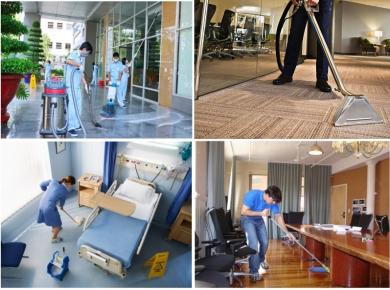


After-hours office cleaning helps businesses reduce noise, avoid disrupting employees, and give cleaning teams better access to work areas. However, once most office staff have left, cleaners may need keys or access cards to enter workspaces, meeting rooms, pantries, storage areas, or other assigned zones.
The main risk is not simply whether a key or card is issued, but whether the company can identify exactly who is holding it, where that person is allowed to enter, how long the access is valid, and whether the item has been returned. A practical key and access card management process should therefore cover access authorization, handover, logging, controlled use, end-of-shift verification, and full return of all access items.
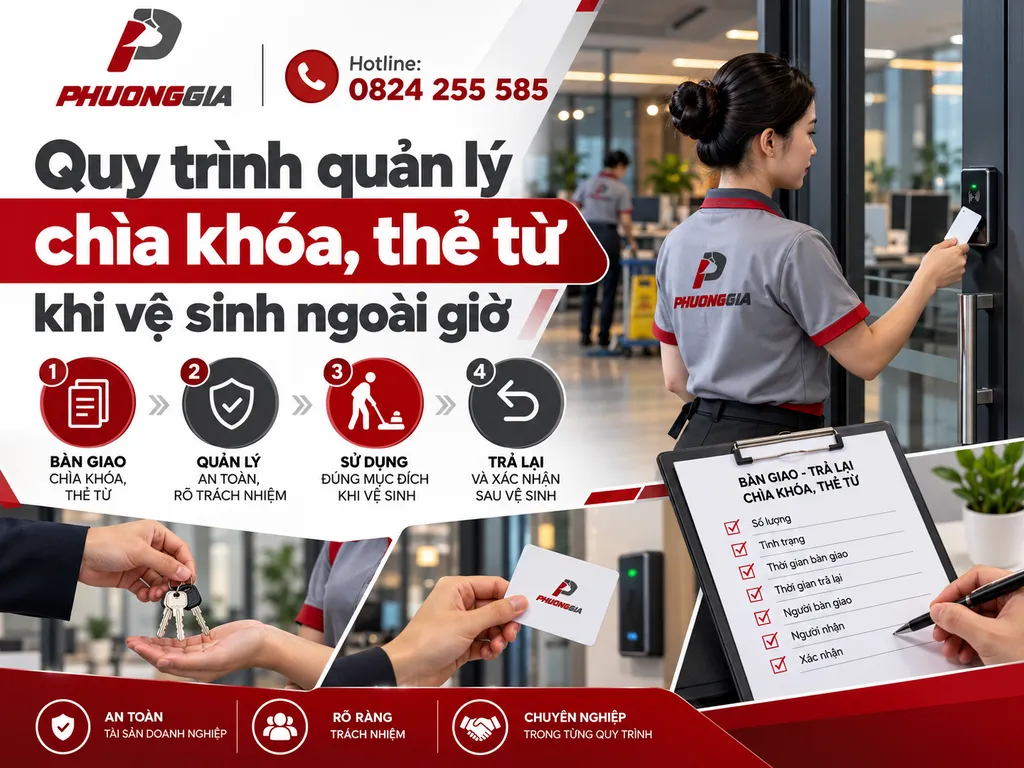
Quick answer: A key and access card management process for after-hours cleaning should include: define required access areas → verify the recipient → record the key or card ID → grant only necessary access → control use during the shift → collect all items after the shift → check the handover log → respond immediately to missing items or unusual access.
Why should keys and access cards be controlled separately during after-hours cleaning?
Keys and access cards require stricter control during after-hours cleaning because fewer employees are present while the cleaning team may need to move through multiple rooms and controlled-access zones. Without a clear process, it becomes difficult to identify the last user if a key goes missing, a door is left unlocked, or someone enters an unauthorized area.
Cleaning assignments may cover workstations, meeting rooms, corridors, pantries, reception areas, and other shared spaces. However, access permissions should not automatically cover the entire office simply because broader access is more convenient for the cleaning team.
A reliable process should always answer four questions: who is holding the item, where can they enter, when can they use it, and has it been returned? If one of these points is unclear, incident tracing becomes much more difficult.
Core principles for issuing keys and access cards to cleaning staff
The most important rule is to grant enough access to complete the assigned task, but no more than necessary. In access management, this is often called the “least privilege” principle: each person receives only the permissions required for their work, their assigned area, and their shift.
A practical system can follow four simple principles:
- Right person: every key or access card must be linked to a specific recipient.
- Right area: access should only cover areas included in the assigned work.
- Right time: access should be used within the approved cleaning shift.
- Right responsibility: the recipient must understand how to protect, return, and report problems involving the item.
This approach reduces dependence on individual memory and creates a consistent standard for Admin, Facility, security, supervisors, and cleaners.
Key and access card management process for after-hours cleaning
The process should begin before the cleaning shift starts and should only end after every issued key and access card has been checked and accounted for. The clearer the staff list, assigned areas, and handover responsibilities are before the shift, the less likely the team is to make improvised access decisions later.
Identify which areas actually require access
Before deciding what type of card to issue, Admin or Facility staff should first determine where each cleaner actually needs to work. This is more effective than issuing a high-level access card and then expecting employees to voluntarily limit where they go.
Office areas can be divided into three groups:
- Authorized areas: workspaces, meeting rooms, corridors, pantries, or other locations included in the cleaning scope.
- Conditional-access areas: rooms that require separate approval or supervision.
- Out-of-scope areas: spaces that cleaning staff are not assigned to enter during the shift.
For example, a cleaner responsible for the second floor does not automatically need access to the third floor. Likewise, a pantry cleaner should not automatically receive access to a server room or asset storage area.
Clearly assign who is authorized to issue access items
The company should define who can issue and receive keys or access cards. Depending on the office structure, this may be an Admin employee, Facility representative, security guard, or another authorized person.
A common mistake is leaving keys at a desk where anyone can take them when needed, or allowing cards to pass from one shift to another without a clear handover.
If the cleaning team has a supervisor, the company may either issue items to individual cleaners or assign them to the supervisor for team control. Both approaches can work as long as it is clear who is responsible for each key or card at any given time.
Verify the recipient before handing over a key or card
The person issuing access items should compare the actual cleaner with the approved shift list. This is particularly important when staff members switch shifts, replacements are assigned, or additional cleaners are added at short notice.
Useful information to verify includes:
- full name of the recipient;
- company or service provider;
- assigned shift;
- assigned cleaning area;
- card ID or key ID;
- handover time;
- name of the person issuing the item.

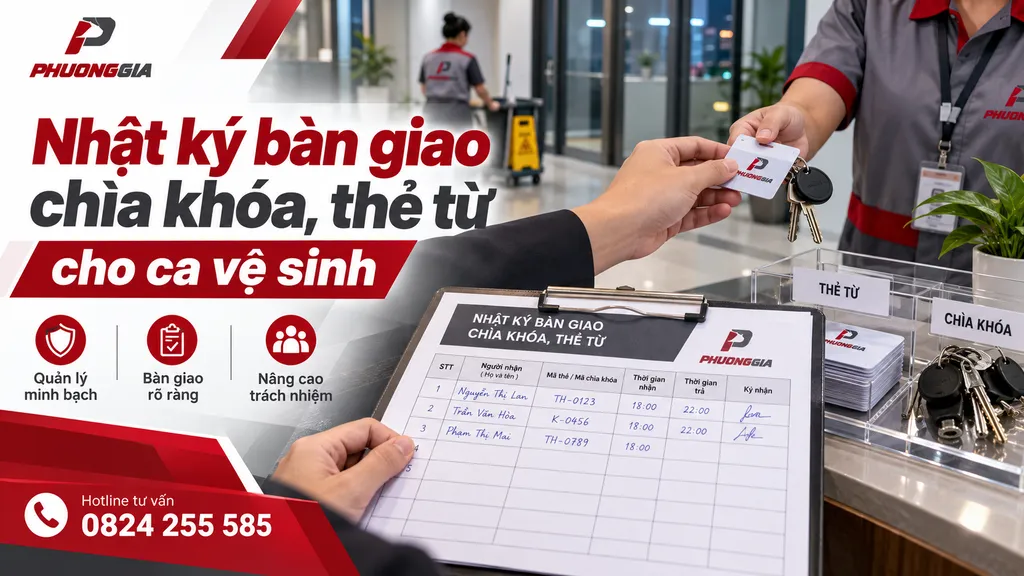
Use a handover log instead of relying on memory
A handover log provides a simple operational record showing who currently holds each key or access card. Small offices may use a paper form or spreadsheet, while larger organizations may combine a handover log with data from an electronic access control system.
| Date | Recipient | Card/Key ID | Authorized Area | Time Out | Time Returned | Issued By | Status |
|---|---|---|---|---|---|---|---|
| 15/09 | Nguyen Van A | CR-012 | Floor 2, Meeting Room | 18:25 | 20:55 | Evening Security | Returned |
| 15/09 | Tran Thi B | K-07 | Floor 3 Pantry | 18:30 | 21:00 | Evening Security | Returned |
If staff frequently change responsibilities or additional rooms are opened during a shift, the company can add a “Notes” column to record the reason for the change and who approved it.
Assign access based on duties, not convenience
If the access control system supports it, card permissions can be limited by floor, door group, room, or time period. For example, an employee assigned to Floor 2 may only need access to doors related to Floor 2 during the cleaning shift.
Not every access control system offers the same configuration options. The company should therefore design its process around the actual capabilities of the installed system rather than assuming every card can be programmed in the same way.
| Staff Group | Required Area | Suggested Access |
|---|---|---|
| Workspace Cleaner | Workstations, corridors | Assigned floor only |
| Pantry Cleaner | Pantry, utility area | Limited to assigned zones |
| Cleaning Supervisor | Areas requiring inspection | Based on supervision scope |
| Restricted Areas | Server room, records, asset storage | Separate approval when required |

Control keys and cards throughout the cleaning shift
Once issued, the cleaner should keep the key or card under personal control. It should not be left unattended on a cleaning trolley, workstation, reception desk, or shared area where another person could use it.
Basic rules may include:
- do not lend the card to anyone who is not assigned to the task;
- do not transfer keys to another cleaner without informing the supervisor;
- do not use the card to enter areas outside the assigned scope;
- do not leave keys or access cards unattended;
- contact the authorized person before entering an additional area;
- update responsibility if another employee takes over the task.
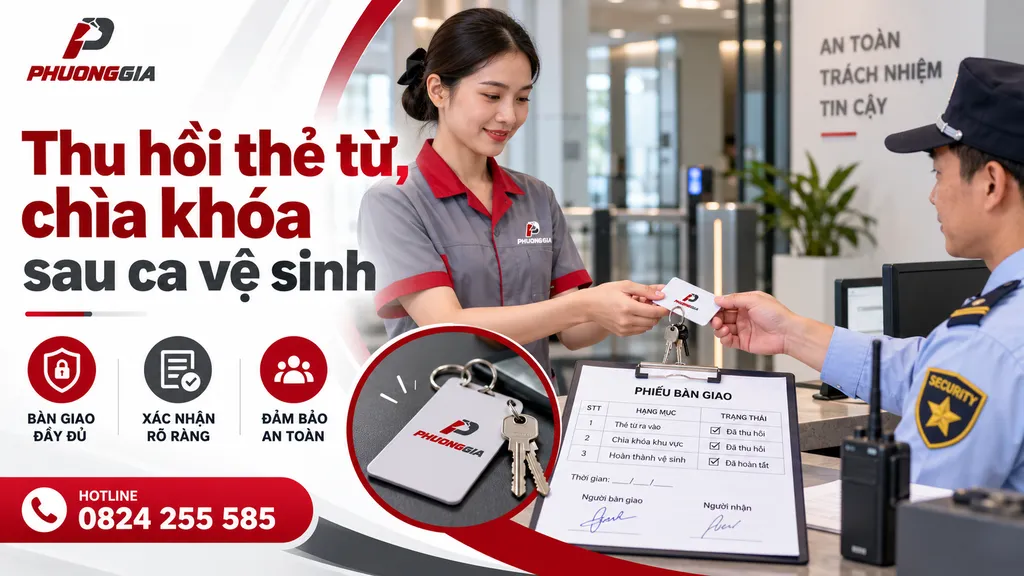
Collect and verify all access items before closing the shift
Finishing the cleaning work does not automatically mean the shift is complete. The shift should only be closed after all issued keys and access cards have been collected, verified, and recorded.
The person receiving the items back should check:
- the number of physical keys returned;
- whether the card ID matches the issued card;
- the actual return time;
- the condition of the key or card;
- whether required doors have been checked;
- whether any access incident occurred during the shift;
- whether the return has been formally acknowledged.
Simply leaving a card on the security desk should not be considered a completed handover if the company's process requires a receiving person to confirm the return.
Revoke or adjust access after the shift when necessary
What happens after the shift depends on the type of access item. Temporary cards and visitor cards will often be collected immediately, while a supervisor's long-term card may remain active if that is consistent with company policy.
Electronic card permissions can be disabled or adjusted when the system supports it. Physical keys require a different approach because they cannot be remotely deactivated. Their control therefore depends on inventory, identification, and responsible custody.
Who is responsible at each stage?
The process works best when responsibilities are clearly assigned. The company should make sure that access permissions match the actual cleaning scope before a key or card is issued.
| Role | Main Responsibility |
|---|---|
| Admin/Facility | Define areas, access permissions, staff lists, and access rules. |
| Security | Verify entry and exit, and issue or collect cards when assigned. |
| Cleaning Supervisor | Manage staff, control changes during the shift, and report incidents. |
| Cleaning Staff | Use access only as authorized, protect the item, and return it after use. |
| Inspection/Acceptance Person | Check the work area and confirm end-of-shift status. |
In a small office, one person may perform several of these roles. The important point is that responsibilities are defined in advance rather than assigned only after a problem occurs.
Which areas should not be included in default access permissions?
Areas containing sensitive data, valuable assets, important documents, or specialized equipment should not automatically be included in the cleaning team's standard access. If cleaning is required, the company can schedule a separate time, issue temporary permission, or provide supervision.
Areas that commonly require additional consideration include:
- server rooms;
- records and archive rooms;
- finance and accounting rooms;
- asset storage areas;
- executive offices;
- technical rooms;
- areas containing important equipment or data.
This does not mean cleaning staff must always be prohibited from entering these spaces. It means that access should reflect the actual work requirement and, where necessary, include a separate approval mechanism.
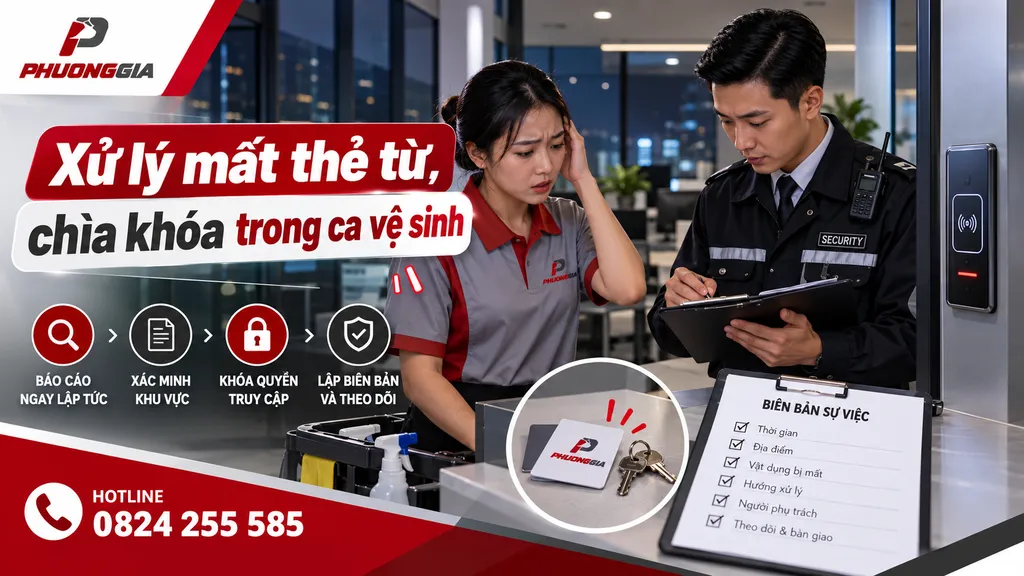
What should you do if a key or access card is lost?
If a key or access card is missing, the incident should be reported immediately rather than waiting until the end of the shift. The first objective is to identify the missing item, the last known user, and the access permissions connected to it.
A practical response process may include:
- notify the supervisor, security team, or Admin immediately;
- record when the loss was discovered;
- identify the last known user;
- check the key or card ID in the handover log;
- disable the card if the system allows it;
- review access logs when available;
- assess the risk associated with a missing physical key;
- create an incident record;
- review the cause and adjust the process if necessary.
Physical keys may require different responses depending on the lock type, whether the lost key can be linked to a specific location, and how sensitive that location is. Replacing a lock is not automatically necessary in every situation.
Key and access card checklist before and after each shift
An effective checklist should be short enough that people actually use it, but complete enough to catch common access-control mistakes. There is little value in creating a long form filled with items that do not support daily operations.
Before the cleaning shift
- Confirm the actual staff list.
- Confirm the assigned area for each person.
- Record each key or card ID.
- Record the issue time.
- Check the physical condition of the item.
- Confirm who issued the item.
- Provide the contact person for access incidents.
- Remind staff which areas are restricted.
Before closing the shift
- Confirm that all keys and cards have been returned.
- Match returned IDs with issued IDs.
- Record the actual return time.
- Check required doors.
- Confirm that no cleaning staff remain inside the area.
- Record any incident that occurred.
- Obtain confirmation from the receiving person.
- Confirm that the shift can be formally closed.
What does a practical after-hours cleaning shift look like?
Suppose the office closes at 6:00 PM and the cleaning team begins work at 6:30 PM. Before the cleaners arrive, Admin sends the approved staff list, assigned areas, and required access information to the evening security team.
At approximately 6:25 PM, the cleaning supervisor and staff arrive at the access control point. Security checks the approved list and issues keys or cards according to each person's assigned area. The Floor 2 cleaner receives Floor 2 access, while the pantry cleaner receives only the access needed for the pantry.
During the shift, an additional room needs cleaning but was not included in the original scope. Instead of borrowing another person's card or searching for a spare key, the cleaner informs the supervisor. The supervisor contacts the authorized office representative for approval before access is granted.
After the work is completed, each cleaner returns the issued item to the supervisor or directly to security according to the agreed process. The receiving person checks the item ID, records the return time, and notes any irregularities. Only after this step is the shift considered complete.
This example shows that access control does not need to create excessive administrative work. The essential requirement is that every change is known, every access item has a responsible holder, and every shift has a clear closure point.
Common mistakes and how to correct them
Most access-management problems come from small operational gaps rather than complex technical failures. Identifying these common mistakes makes the process easier to standardize.
| Common Mistake | Operational Risk | Better Practice |
|---|---|---|
| Issuing a card without recording its ID | The company cannot identify the exact card in use | Record both the recipient and card ID |
| Multiple people passing one card between them | The last user becomes difficult to identify | Assign one responsible holder |
| Issuing excessively broad access | Staff can enter areas outside their work scope | Limit access by area |
| Not recording issue and return times | Incident timelines become difficult to reconstruct | Record actual times |
| Failing to collect access items after the shift | The item remains outside company control | Verify return before closing the shift |
| Staff replacement without updating the list | Access may be issued to the wrong person | Update the list before issuing access |
| Physical keys without internal identification | Inventory becomes difficult | Use an appropriate internal key ID |
What should happen to access permissions when cleaning staff change?
When a cleaner leaves, changes shifts, moves to another area, or when the service provider changes, access permissions should be reviewed immediately. A card or key should not be assumed to be under control simply because the employee no longer appears on the work schedule.
The review should include:
- collect cards from staff who no longer require access;
- confirm that physical keys have been returned;
- adjust electronic permissions where applicable;
- update the approved staff list;
- confirm each person's new assigned area;
- issue new permissions based on the updated duties.
A timesheet and an access-control list serve different purposes. Removing an employee from the work schedule does not automatically remove their electronic access rights.
How long should handover records be retained?
There is no single retention period that is suitable for every office. The appropriate period should depend on internal policy, building requirements, service contracts, the sensitivity of the areas involved, and the storage capability of the access control system.
The important point is consistency. One shift should not keep records for one week while another keeps them for several months unless there is a defined reason for the difference.
If the log contains personal information or electronic access records, the company should also manage storage and viewing permissions according to its internal information-handling policies.
Frequently asked questions about keys and access cards during cleaning shifts
The following questions commonly arise when businesses organize cleaning work after normal office hours.
Should cleaning staff be given a master access card?
A master card should not be issued by default simply because it is convenient. Access should match the areas that actually need cleaning. If broader access is genuinely required, the company should define who holds the card, when it may be used, and how it must be returned at the end of the shift.
Can a cleaning team share one access card?
Yes, in some operating models, but one person should still be responsible for the card. If the card is continuously passed between employees without any record, the company will have difficulty identifying who used it at a specific time.
Who should hold the keys during the cleaning shift?
The person recorded in the handover log or the designated cleaning supervisor should normally remain responsible. If a key must be transferred to another employee to complete a task, the supervisor should know about the change and update responsibility accordingly.
What should happen if a cleaner forgets to return an access card?
The company should contact the person immediately, record the card as not yet returned, and consider temporarily disabling the card if the access system allows it. Once the card is returned, the actual return time and the reason for the delay should be recorded.
Should every cleaner receive an individual access card?
Individual cards can improve traceability when the system supports them. However, smaller offices may still manage access through a supervisor or team-based arrangement. The appropriate method depends on staff numbers, the number of controlled areas, and the capabilities of the access control system.
Should access permissions be changed when cleaning staff are replaced?
Yes. When an employee leaves, changes shifts, or moves to another area, existing access should be reviewed. Electronic access may need to be adjusted or disabled, while physical keys should be checked and fully returned.
What information should be included in a key and access card handover log?
At minimum, the log should include the date, recipient, card or key ID, authorized area, issue time, return time, issuing person, and return status. Any staff change, additional access request, or incident during the shift should also be recorded when relevant.
Conclusion
Key and access card management during after-hours cleaning does not need to be complicated. An effective process should allow the company to answer five simple questions: who has the item, where can they enter, when can they use it, has it been returned, and how can the company trace the situation if something goes wrong?
Instead of relying on the memory of individual security guards or supervisors, businesses should standardize staff lists, key and card IDs, access areas, issue-and-return records, and end-of-shift verification. When these steps are consistently applied, cleaning teams can still work efficiently while Admin, Facility, and security staff maintain appropriate control over office access.